Can I Fix a Wobbly Ceiling Fan Without Calling an Electrician?
A wobbly ceiling fan is almost always fixable without professional help. The wobble is mechanical in nearly every case — a loose screw, an unbalanced blade, or a mounting bracket that has worked itself free over time — and none of those faults require rewiring or specialist tools.
Before anything else: turn the fan off at the wall switch and wait for the blades to stop completely. If the fan is controlled by a remote or smart switch, flip the circuit breaker too. You should never touch the mounting hardware while the fan can spin.
Why Do Ceiling Fans Wobble?
Most wobble comes from one of three places: the mounting bracket where the fan meets the ceiling box, the blade irons (the metal arms that hold each blade), or the blades themselves being unbalanced. A fourth, less common cause is a worn or bent motor shaft, which is harder to fix yourself and is usually accompanied by a grinding noise rather than a simple shake.
Knowing which is which matters because you fix each one differently. A loose bracket is a two-minute job with a screwdriver. A blade-balance problem takes a little more patience.
Step 1: Tighten the Canopy and Mounting Bracket
Slide the canopy cover (the decorative dome at the ceiling) downward to expose the mounting hardware. You will see either a ball-and-socket bracket or a flush-mount plate screwed directly to the ceiling box.
- Ball-and-socket (downrod mount): Grip the ball housing and try to move it. If it shifts, tighten the setscrew on the side of the housing with a hex key (Allen wrench). The fan should sit firmly in the socket with no lateral play.
- Flush-mount (hugger style): Check that all mounting screws going into the ceiling box are snug. Loose screws here cause pronounced wobble because nothing is absorbing the motion.
Also confirm the ceiling box itself is not moving. Push the box firmly with your palm. If the box flexes or spins, it is not rated for fan support and must be replaced with a fan-rated box before you go further. A standard light-fixture box is not strong enough for the rotational load of a fan motor, and continuing to run the fan risks the entire fixture pulling free of the ceiling. Fan-rated boxes are widely available and install without rewiring, but if the existing wiring is confusing, that is the right moment to call a professional.
Step 2: Check and Tighten the Blade Irons
Each blade is attached to the motor housing by a metal bracket called a blade iron (sometimes called a blade arm). These brackets have two sets of screws: one set into the blade itself, another into the motor hub.
With the power off, hold each blade iron firmly and try to rock it. Even a tiny amount of movement at that pivot point translates to a visible shimmy once the fan is spinning fast. Tighten every screw — both sets on every arm — before moving on. A magnetized screwdriver makes this easier because you are often working overhead in awkward angles.
While you are there, look at the blade irons themselves. If one is visibly bent downward or upward compared to the others, gently bend it back with your hands until it matches. Blade irons are thin stamped metal and do flex, especially if a blade has ever been bumped hard.

Step 3: Check That the Blades Are Flat
Blade warp is more common than people expect, especially in rooms with high humidity or temperature swings. A warped blade does not sit at the same angle as its neighbors, which throws the fan’s rotation off balance.
To check, hold a long ruler or a straightedge vertically next to each blade tip while a helper (or a piece of tape on the wall at blade-tip height) gives you a reference. Alternatively, set a yardstick on top of the blade and see whether the blade rocks on it. You are looking for any blade that sits noticeably higher or lower at the tip than the others.
A warped wooden blade can sometimes be flattened by leaving it weighted on a flat surface in a dry room for several days, though results vary and are not guaranteed. The practical fix is usually to replace the blade — most manufacturers sell replacement blades, and a matched set is not expensive.
Step 4: Balance the Blades With a Balancing Kit
If everything is tight and flat but the fan still wobbles, the blades are aerodynamically unbalanced: slight differences in weight between them create a net force that pulls the fan off-center as it spins. This is the most common cause of wobble in fans that have been properly installed.
Most fans ship with a plastic balancing clip in the parts bag. If yours is missing, balancing kits are sold cheaply at hardware stores — the kit includes a clip that pinches onto a blade and small self-adhesive weights.
How to use the clip:
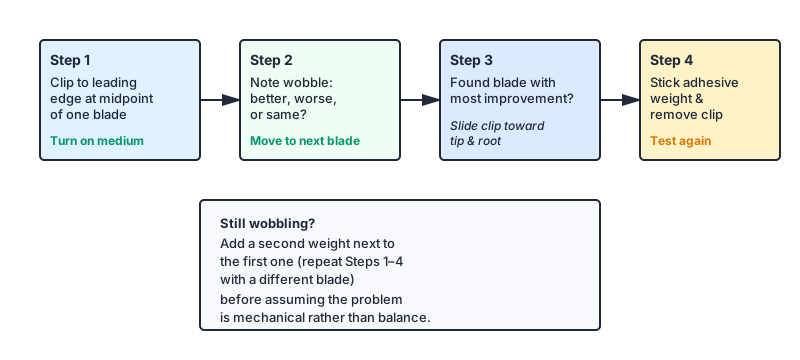
- Clip it to the leading edge of one blade at the midpoint.
- Turn the fan on at medium speed and note whether the wobble is better, worse, or the same.
- Move the clip to the next blade and repeat.
- When you find the blade where the clip reduces wobble the most, slide it toward the tip and then toward the root to find the position of maximum improvement.
- Stick the adhesive weight at that spot and remove the clip.
Sometimes one weight is not enough. Add a second weight next to the first before assuming the problem is mechanical rather than balance-related.
What If the Wobble Is in the Downrod?
On taller ceilings, fans hang on a metal tube called a downrod. A downrod that is too long — or a ceiling with a steep slope that is not accommodated by an angled mounting kit — can sway rather than just wobble. Check that the downrod pin (the cotter pin or hitch pin that locks the rod into the motor housing) is properly seated. If the pin is missing or the hole has worn oval, the downrod will rock inside the housing.
Angled ceilings require a purpose-made sloped canopy or an angled ceiling adapter. Running a fan on a sloped ceiling with a flat-ceiling bracket puts uneven stress on the mounting and causes persistent sway that no amount of blade balancing will fix.
When to Stop and Call a Professional
Most wobble fixes fall well within DIY territory. Stop and get an electrician involved if:
- The ceiling box is moving and you cannot safely replace it yourself (for example, the existing wiring is aluminum, the junction is in a finished ceiling with no attic access, or you are simply not comfortable with live wires).
- The motor housing feels hot to the touch or you hear grinding, which points to a bearing failure rather than a balance problem.
- The fan has dropped perceptibly from the ceiling or the canopy will not sit flat no matter how you tighten the bracket.
- You open the canopy and find wiring that looks scorched, has melted insulation, or uses connections you do not recognize.
None of the mechanical steps above — tightening screws, balancing blades, checking blade irons — involves the wiring at all. The rule is simple: if you are tightening hardware or adjusting blades, you are in safe DIY territory as long as the power is off. If you are touching wire connections, that is a different job.
Once your fan is spinning smoothly again, keeping it dust-free will help it stay balanced, so check out How to Clean a Ceiling Fan: 7 Simple Steps for Spotless Blades for an easy maintenance routine.
Frequently Asked Questions
Is a wobbling ceiling fan dangerous?
Mild wobble is mostly a nuisance, but severe wobble that is ignored can loosen mounting hardware over time and, in the worst case, cause the fan to fall. It also puts extra strain on the motor. Fix wobble when you notice it rather than letting it get worse.
How much wobble is normal for a ceiling fan?
A correctly installed and balanced fan should have no visible wobble at any speed setting. A barely perceptible shimmy at the highest speed is common and generally harmless, but if you can see the blades swaying from across the room at medium speed, that is worth addressing.
Can I use coins instead of a proper balancing weight?
Temporarily, yes. Some people tape a coin to the top of a blade while testing balance. For a permanent fix, use the proper adhesive weight that came with the balancing kit — it is designed to stay put in heat and humidity, and a coin held by household tape often falls off over time.
Why does my ceiling fan wobble only at high speed?
At low and medium speeds, the aerodynamic forces are small enough that a slight imbalance does not matter much. At high speed, even a small weight difference between blades generates a proportionally larger centrifugal pull. If wobble only appears at high speed, the blade-balancing steps above are almost certainly the fix.
My fan is new and already wobbles. What did I do wrong?
The most common installation mistake is not tightening the blade iron screws fully, or missing the setscrew on the ball-and-socket bracket. Also check that the blades are seated fully against their irons with no gap. Some fans also come from the factory with a blade that is slightly off, which is not your fault and is fixed with the balancing clip.