Can You Use a Mandoline Slicer Without Cutting Yourself?
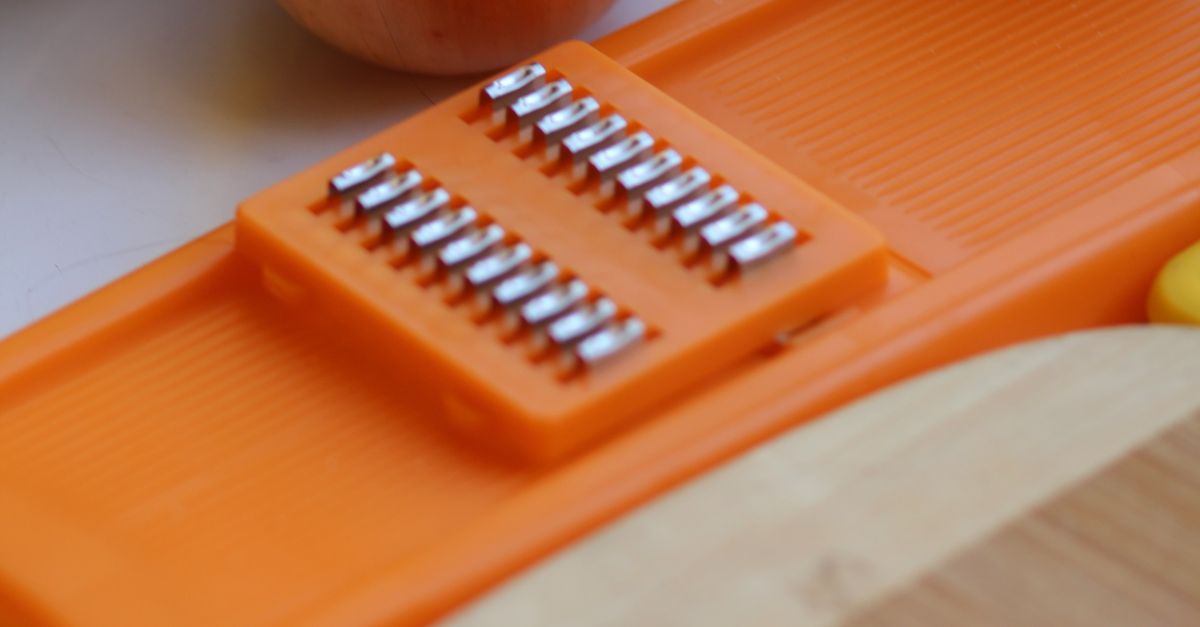
A mandoline slicer will halve your prep time and produce paper-thin, restaurant-quality cuts that a chef’s knife rarely matches. It will also send you to urgent care faster than almost any other kitchen tool if you get complacent. The blade is exposed, rigid, and indifferent to fingertips. The good news is that most cuts happen for the same handful of reasons, all of which are avoidable.
What Makes a Mandoline So Dangerous in the First Place?
The risk is structural, not just careless. On a chef’s knife the blade moves; on a mandoline the food moves across a stationary blade. That reversal catches cooks off guard because the feedback loop is different. You push, the food seems fine, and then the last centimetre of vegetable slides your fingers directly across a razor edge before your brain has time to react.
The blade is also typically much sharper per square millimetre than a home cook expects. Mandoline blades are ground to a fine bevel specifically to shear through dense root vegetables, and that geometry cuts skin with almost no resistance.
Two other factors compound the risk:
- Speed: Slicing is fast, so the rate of repetitions is high, and complacency builds quickly.
- Wet hands or a wet food surface: Water reduces friction between the food and the hand guard, which can cause the food to slip unpredictably.
Cut-Resistant Gloves: Worth It or Overcautious?
Cut-resistant gloves are worth it, and most professional kitchens require them whenever a mandoline is in use. They are made from materials such as HPPE (high-performance polyethylene fibre), Kevlar, or stainless steel mesh, and they are rated on a standardised cut-protection scale. The mesh gloves used in butchery offer the highest protection but reduce dexterity; fibre gloves are a practical middle ground for home use.
Wear the glove on your guide hand only (the one touching the food) so you keep full feel in your cutting hand. Make sure the glove fits snugly: a loose glove can bunch up and push the food sideways.
A glove is not a replacement for technique. It reduces the severity of a cut; it does not guarantee you will not feel the blade at all.
Using the Hand Guard Correctly
Every mandoline ships with a hand guard, typically a plastic or metal plate with prongs or spikes that grip the food. Most injuries happen when the hand guard is ignored, misused, or the food is too small for it to grip properly.
Use the guard from the first slice, not just near the end. Cooks often grip the food by hand for the first few passes because the vegetable feels stable, then switch to the guard for the final passes. That logic is backwards: the early passes establish a rhythm, and your hands end up near the blade repeatedly before the guard is introduced.
For the guard to work:
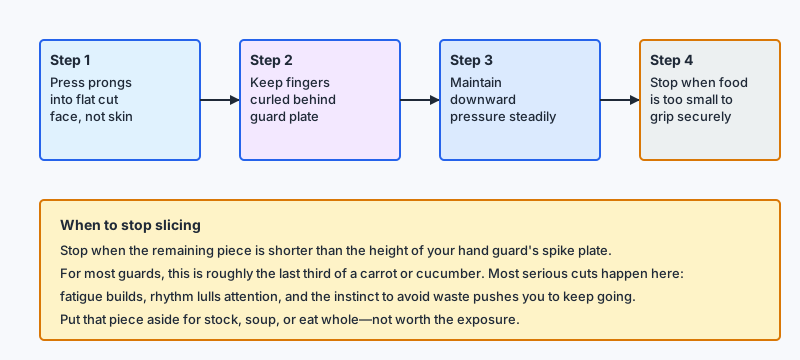
- Press the prongs firmly into the flat cut face of the vegetable, not the skin side.
- Keep your fingers curled behind the guard plate, not resting on top of the food above it.
- Maintain downward pressure as you push forward; do not let the food rock from side to side.
- Stop when the food is too small to seat on the guard securely. That last stub is not worth slicing by hand.
When Should You Stop Slicing?
Stop when the remaining piece is shorter than the height of your hand guard’s spike plate. For most guards this is roughly the last third of a carrot or cucumber. Put that piece aside for stock, soup, or a snack you eat whole. The thin slices you would gain from pushing further are not worth the exposure.
This is the point where most serious cuts happen: fatigue is real, the rhythm of slicing has lulled your attention, and the instinct to avoid waste pushes you to keep going with bare fingers.
Surface Setup and Stability
A mandoline that moves during slicing is a mandoline that will cut you. Before the first slice:
- Place a damp kitchen towel or a silicone mat under the mandoline to stop it sliding.
- If the mandoline has fold-out legs, deploy them so the cutting surface is elevated at a consistent angle.
- Set it on a surface at about hip to lower-chest height. Too low and you are leaning over the blade; too high and your guide arm has poor leverage.
- Brace the far end of the mandoline against the back of the board or the counter edge if there is nothing to clip it to.
Wet or greasy countertops are a genuine hazard. Wipe the surface dry before you start.
Blade Selection and Thickness Settings
Mandolines typically offer a straight blade for even slices and julienne or wavy blades for decorative cuts. The straight blade is the safest to learn on because the food tracks predictably. Julienne blades involve more lateral resistance, which can cause the food to stall and then catch suddenly.
For thickness, start thicker than you think you need. A 3–4 mm setting feels more stable than a 1 mm setting because the food takes slightly longer to pass the blade, giving you more control. Once you are comfortable with the motion, reduce thickness gradually.
Some mandolines let you fine-tune thickness with a dial; others use discrete notched settings. Know which type you have: a dial that slips can suddenly drop to a thinner setting mid-prep.
Cleaning Without Cutting Yourself
Cleaning a mandoline is when a second wave of injuries occurs. The blade is now coated in juice and pulp, which makes it look less sharp than it is. Do not swipe a sponge or cloth across the blade face.
Safer cleaning steps:
- Remove the blade if it is detachable; handle it only by the spine or a designated safe-touch area.
- Rinse the frame under running water with the blade pointing away from you.
- Use a long-handled brush or a folded thick cloth moving parallel to the blade edge, not across it.
- Dry the blade with a cloth held at the spine, never draped over the edge.
- Store the mandoline in its box or a blade guard sleeve when it is not in use.
Do not leave a mandoline in a dish rack where someone else could reach for it without knowing the blade orientation.
Choosing the Right Vegetables and Prep Technique
Not every vegetable behaves the same way on a mandoline, and picking the wrong prep approach multiplies the risk.
Dense root vegetables (carrots, beetroot, parsnips): Slice lengthways if possible to create a flat, stable face. A round carrot rolling on the blade is unpredictable; a carrot cut in half lengthways sits flat.
Watery or fragile vegetables (tomatoes, cucumber, courgette): These are slippery. Chill them first to firm up the flesh, and wipe them dry before slicing. A cold, dry cucumber tracks better than a room-temperature wet one.
Cabbage and fennel: Halve through the core so the core acts as a handle and grip point for the guard. Once the core is gone, stop and switch to a knife.
Onions: The layers can separate mid-slice and feed unevenly. Keep the root end intact and slice from the top down, using the root-end as the last handle.
Avoid: very small items (cherry tomatoes, radishes under 3 cm diameter) that cannot be gripped reliably by any guard. Slice those with a knife.
Frequently Asked Questions
Do I really need a cut-resistant glove for occasional home use?
Yes, arguably more so than for daily use. Someone who uses a mandoline every day builds reliable muscle memory and consistent technique. Occasional users encounter the tool with inconsistent familiarity, which is exactly when accidents happen. A glove takes two seconds to put on and can prevent a serious laceration.
What should I do if the blade catches the food and stops suddenly?
Let go of the food. Do not try to push harder or shake the food free while your hand is near the blade. Lift the food away from the top, inspect the blade for a chip or obstruction, clear it with a brush or tongs, then resume. Forcing a stall almost always causes a sudden slip.
Is a more expensive mandoline safer than a cheap one?
Not automatically. Higher-priced models sometimes have better-fitting hand guards, more stable frames, and sharper blades (a sharper blade requires less force and is therefore more predictable). But a cheap mandoline used with the right technique is safer than an expensive one used carelessly. Fit and stability of the hand guard matter most; check those regardless of price.
Can children use a mandoline with supervision?
Most safety guidance from kitchen professionals advises against it for young children. The exposure time to the blade per slice is very short and the required fine motor control is high. Adolescents can learn with close supervision, a well-fitted cut-resistant glove, and only on stable, large vegetables. When in doubt, a mandoline is one tool to keep out of reach.
Why does my mandoline leave ragged edges instead of clean slices?
The most common cause is a dull blade. A blade that must be forced through the food causes the food to compress and tear rather than shear cleanly. This also increases the pressure you apply per pass, which increases risk. Check whether the blade is replaceable or sharpenable for your model; many straight mandoline blades can be honed with a ceramic rod at a shallow angle.