Best Vacuum Cleaners for Pet Hair: What Actually Works
If you share your home with a dog, cat, or both, you already know that ordinary vacuums lose the battle against pet hair. The fur weaves into carpet fibers, clings to upholstery, and somehow migrates to rooms the pet never enters. The right vacuum does not just suck it up — it untangles hair from brush rolls, holds enough suction to pull embedded fibers loose, and filters the air so dander does not cycle back into the room.
This guide covers what separates a pet-hair vacuum from a generic one, which features actually matter versus which are marketing noise, and how to match the right type to your floors and lifestyle.
What Makes a Vacuum Good at Pet Hair?
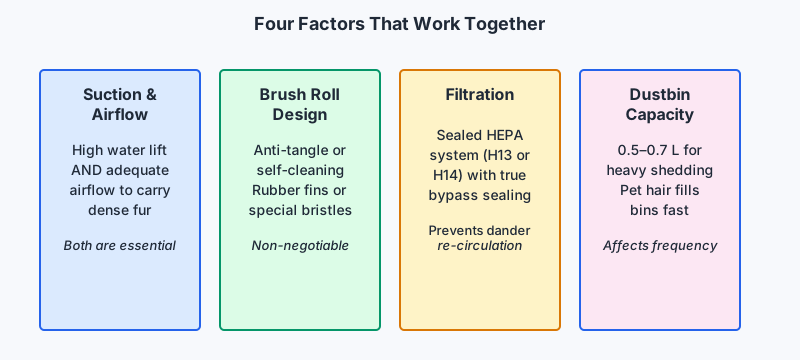
Pet hair removal comes down to four things that work together: sustained suction, brush roll design, filtration, and dustbin capacity. Miss one and the whole system underperforms.
Suction and airflow — Raw suction (measured in Pa or “water lift”) tells you how hard the motor pulls, but airflow (CFM) tells you how much debris it can carry. Both need to be adequate; a vacuum with high lift but low airflow will stall on dense fur. Manufacturers rarely publish CFM for household vacuums, so the practical proxy is user reports on thick-pile carpet with long dog hair — a situation many spec sheets cannot capture.
Brush roll design — Standard brush rolls tangle with long hair within minutes. Look for anti-tangle or self-cleaning brush rolls that cut or comb hair off the roller continuously. Some use rubber fins (common on Dyson and Shark designs) rather than bristles; rubber creates static friction that grabs hair without wrapping it. The trade-off is that rubber fins sometimes underperform on deep-pile carpet where bristles dig in better.
Filtration — Pet dander particles are small enough to pass through felt filters and re-enter the air. A sealed HEPA system (filter rated H13 or H14 in EU terms, and genuinely sealed against bypass leakage) keeps dander and fine dust contained. “HEPA-level” or “HEPA-style” filters are not the same thing — check that the entire machine is sealed, not just the filter element.
Capacity — Pet hair is low-density and fills a dustbin fast. A 0.2-liter cup that works fine for a tidy studio will need emptying twice per room in a heavy-shedding household. Aim for at least 0.5–0.7 liters for uprights, or plan on frequent empties with compact machines.
Which Vacuum Type Fits Your Home?
No single form factor is best for every situation. Pet hair tends to turn up in multiple places — deep carpet, hard floors, upholstery, car seats, stairs — and different machines handle these very differently.
| Type | Best at | Weakest at | Typical capacity | Trade-off |
|---|---|---|---|---|
| Upright | Deep-pile carpet, large rooms | Stairs, under furniture | 0.8–2 L | Heavier, less maneuverable |
| Canister | Hard floors, stairs, flexible reach | Lugging between floors | 1–2.5 L | Two pieces to carry |
| Cordless stick | Quick daily pick-up, hard floors | Extended sessions on thick carpet | 0.3–0.8 L | Battery life limits run time |
| Robot | Autonomous daily maintenance | Stairs, very deep carpet | Small (frequent empty) | Cannot replace a deep clean |
| Handheld | Upholstery, car interiors, spot-clean | Whole-room cleaning | 0.15–0.4 L | Single-task tool |
Upright vacuums
Uprights deliver the strongest sustained suction for wall-to-wall carpet — the power head stays in firm contact and the motor sits close to the action. They are the go-to for homes with large carpeted areas and heavy shedders. The downside: they are heavier, awkward on stairs, and struggle to reach under low furniture without attachments.
Cordless stick vacuums
Cordless sticks have improved substantially in suction and battery life, but the physics still constrain them: smaller motors and limited battery capacity mean they genuinely underperform uprights on deeply embedded hair in thick carpet. Where they shine is daily maintenance — a two-minute pass after the dog gets off the sofa, or a quick sweep of the kitchen floor. In a home with mostly hard floors and a moderate shedder, a high-end cordless stick can be the only vacuum you need.
Robot vacuums
A robot vacuum does not replace a proper vacuum, but it dramatically reduces how often you need one. Running it daily keeps the surface load manageable so your weekly vacuum is faster and more effective. Pet-specific robots feature rubber extractors instead of bristle rolls and larger dustbins; without those features, hair tangles around the brushes and the robot spends its time redistributing fur rather than collecting it.
Features Worth Paying For (and Features That Are Not)
Worth it
Anti-tangle brush roll — If you have a dog or cat with hair longer than about 2 cm, this is non-negotiable. The time saved cleaning brush rolls adds up quickly over a year of vacuuming.
Sealed HEPA filtration — Important if anyone in the house has allergies or asthma triggered by pet dander. Without a sealed system, fine dander escapes around the filter and the air quality after vacuuming can be worse than before.
Motorized pet tool — A small, motorized brush head for upholstery does far more work than a plain suction nozzle. The rotating bristles loosen embedded hair that static tools cannot dislodge.
Large dustbin or easy-empty mechanism — Either works, but pick one. Fiddly emptying mechanisms that contact the debris are particularly unpleasant with pet hair.
Mostly marketing
“Pet” branding on a standard machine — Many vacuum lines add “Pet” to a model name and include a lint roller or a small attachment. Check that the underlying machine has the filtration and brush roll design to justify the label.
Suction power in watts or amps — Motor wattage tells you how much electricity the machine consumes, not how effectively it cleans. A 2,400 W vacuum can underperform a 1,400 W model with better airflow engineering.
Odor filters and “neutralizing” technology — Activated carbon layers can reduce odors modestly, but they do not eliminate the source. Regular emptying and washing of filters does more for smell than a specialty layer.
Recommended Vacuums by Category
The products listed in the structured section below represent genuinely well-regarded options in each category. Within each type, here is what to look for when comparing models.
For heavy-shedding households with carpet: an upright or full-size canister with a motorized brush roll, sealed HEPA filtration, and a dustbin of at least 1 liter. Dyson Ball Animal models and Shark’s Navigator/Apex lines are consistently well-reviewed in this segment.
For hard floors with light shedding: a cordless stick with a soft roller head (designed for hard floors, not carpet) plus a HEPA filter. Dyson’s V-series and Shark’s IZ/IQ lines compete closely here.
For whole-home coverage on a budget: consider a canister vacuum — they often offer better suction per dollar than uprights and handle both carpet and hard floors with the right attachments. Miele’s C1 and C3 lines have a long track record for durability.
For autonomous daily maintenance: a robot vacuum with rubber extractors. The iRobot Roomba j-series, Roborock Q-series, and Shark AI models are designed specifically around pet hair with larger dustbins and self-cleaning extractors.
How Often Should You Vacuum With Pets?
The honest answer: more often than most people want to. For light shedders (single short-haired cat, small dog), vacuuming two or three times per week is typically enough to stay ahead. For heavy shedders — Huskies, Golden Retrievers, Maine Coon cats — daily vacuuming in high-traffic areas is not excessive, especially during seasonal shedding peaks.
A practical system that many pet owners settle on: run a robot vacuum daily on hard floors, do a stick-vacuum pass of high-use upholstery every few days, and use the main upright or canister for a thorough weekly clean of carpets.
Regular grooming of the pet itself reduces the vacuum’s workload considerably — weekly brushing for short-haired breeds, more frequent for long-haired ones. Some breeds with double coats shed in concentrated bursts rather than constantly, which means you will hit stretches where even your best vacuum barely keeps up; this is normal, not a sign you need a new machine.
Between vacuuming sessions, How to Remove Pet Hair from Furniture: Quick Fixes For Fabric can help you tackle the hair that settles into couches and cushions.
Frequently Asked Questions
Do I really need a vacuum specifically made for pet hair?
Not necessarily — but you need one with the right features: an anti-tangle brush roll, sealed HEPA filtration, and adequate dustbin size. Some non-pet-labeled vacuums have all three. The “pet” label is useful as a shortcut because it usually signals those features, but check the specs rather than trusting the branding.
Is bagless or bagged better for pet hair and allergies?
Bagged vacuums have an edge for allergy sufferers because you dispose of the bag without touching the debris — less chance of dander release on emptying. Bagless machines are more convenient and cheaper to run day-to-day, but emptying the dustbin (especially outdoors) is worth the extra step. Either type works well if the filtration system is sealed.
Why does my vacuum lose suction so quickly when cleaning pet hair?
The most common causes are a clogged filter, a tangled brush roll, or a full dustbin. Pet hair clogs filters faster than household dust — check and clean or replace filters at least twice as often as the manufacturer suggests for pet-free homes. Brush roll tangles create drag that reduces airflow even if suction at the motor seems fine.
For a deeper dive into keeping your machine running at full power over the long haul, check out Vacuum Cleaner Suction: Keep It Powerful Long-Term.
Can a robot vacuum handle pet hair on its own?
For maintenance, yes — a good robot vacuum running daily keeps surface hair from accumulating into dense mats. It cannot do a deep clean on thick-pile carpet or reach furniture edges reliably. Think of it as reducing how hard your main vacuum has to work, not replacing it.
How do I stop pet hair from clogging the brush roll?
Anti-tangle brush rolls are the most effective long-term fix. If your current vacuum has a standard bristle roll, clean it after every session by cutting any wound hair with scissors before pulling it free. Some owners keep a seam ripper (a sewing tool with a small hook) next to the vacuum — it threads under wrapped hair and cuts it loose in seconds without damaging bristles.