How Do You Make Simple Syrup for Drinks?
Simple syrup is just sugar dissolved in water, and the basic formula takes about five minutes. Yet small decisions — the ratio you choose, whether you add heat, how long you cook it — change how the syrup behaves in a cocktail, lemonade, or iced coffee. Getting those decisions right is what separates a thin, crystallizing batch from one that stays smooth and lasts weeks in your fridge.
The Two Core Ratios (and When to Use Each)
Most recipes fall into one of two formulas: 1:1 (equal parts sugar and water by volume) or 2:1 (two parts sugar to one part water, also called rich syrup). Neither is wrong; they just behave differently.
| 1:1 Simple Syrup | 2:1 Rich Syrup | |
|---|---|---|
| Sweetness per teaspoon | Moderate | Roughly twice as sweet |
| Texture in the glass | Thin, watery | Silkier, slightly viscous |
| How much you add | More to hit sweetness | Less — easier to over-pour |
| Shelf life (refrigerated) | About 2–3 weeks | Can last a month or longer |
| Best use | Lemonade, iced tea, light cocktails | Craft cocktails, cold brew, any drink where dilution matters |
A 1:1 syrup is forgiving and easy to eyeball. The 2:1 version is less likely to dilute a spirit-forward cocktail and tends to hold off crystallization longer because the higher sugar concentration inhibits microbial growth. For most home bar purposes, pick whichever you will actually use — there is no point keeping a rich syrup around if you only make pitchers of lemonade.
Hot Method vs. Cold Method
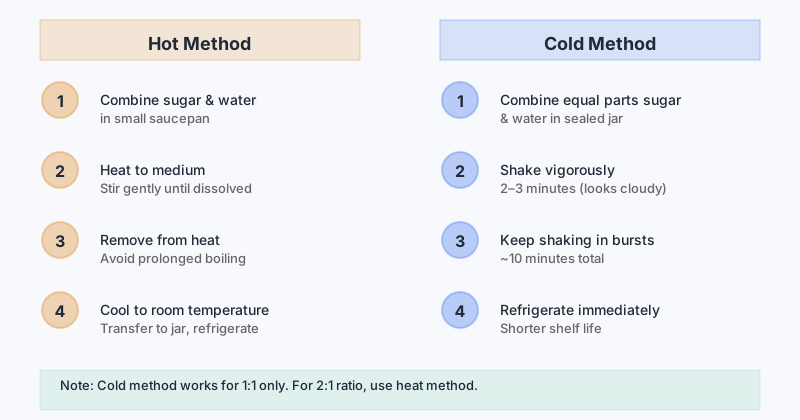
Hot method (standard): Combine sugar and water in a small saucepan over medium heat. Stir gently until the sugar is completely dissolved, then remove from heat. Do not let it boil hard or for a long time — prolonged boiling can partially invert the sugar, which changes the flavor and texture in ways that are mostly harmless but sometimes unwanted. A gentle simmer until the liquid clears is all you need. Let it cool to room temperature, then transfer to a clean glass jar or bottle and refrigerate.
Cold method (no-heat): Combine equal parts sugar and water in a sealed jar and shake vigorously for two to three minutes. The syrup will look cloudy at first. Keep shaking in short bursts over about ten minutes and most of the sugar will dissolve. Ultra-fine or caster sugar dissolves much faster than standard granulated; regular table sugar works, it just takes patience. The cold method produces a slightly less stable syrup and a shorter shelf life, but it is genuinely useful when you do not want to run the stove or wait for something to cool.
For a 2:1 ratio, skip the cold method — the sugar concentration is too high for water alone to dissolve it without heat.
If you’re also looking to dial in your morning routine, How to Brew Better Coffee at Home: Why Grind Timing Beats Bean Price explains how small timing tweaks can make a big difference in flavor.
Variations Worth Knowing
Once you have the base technique, flavored syrups follow the same logic: you are infusing the hot liquid before or after dissolving the sugar.
Herb syrups (mint, rosemary, thyme): Add a small handful of fresh herbs to the hot syrup off the heat. Steep for 15–30 minutes, taste, then strain through a fine-mesh sieve. Mint steeps quickly and can go bitter if you leave it too long; woody herbs like rosemary are more forgiving.
Citrus syrups: Peel strips of lemon, lime, or orange (avoid the white pith — it adds bitterness) and steep them in the hot syrup for 20–30 minutes. Strain before storing.
Spiced syrups: Whole spices — cinnamon sticks, star anise, cardamom pods — go into the saucepan with the sugar and water and simmer gently together. A five-minute simmer is usually enough to pull flavor without making the syrup medicinal.
Honey syrup: Mix one part honey with one part warm water and stir until fully combined. No stove required. Honey syrup adds a distinct floral note and works especially well in whiskey and tequila drinks. It is thicker than standard simple syrup, so start with less.
Brown sugar syrup: Swap white sugar for light or dark brown sugar in the same 1:1 ratio. The molasses in brown sugar gives you a richer, slightly caramel flavor that pairs well with rum, bourbon, and fall-style drinks.
Demerara syrup: Made from raw demerara sugar, this has a nutty, complex sweetness and is a classic in Old Fashioneds. Use the 2:1 ratio for best results.
For another drink-focused deep dive, check out 7 Best Coffee Brewing Methods at Home, Ranked to see how different brewing techniques compare.
Storage and Shelf Life
Store simple syrup in a clean, airtight glass container in the refrigerator. The exact shelf life depends on the sugar concentration, whether the container was sterilized, and whether any infusions were added. As a general guide:
- A plain 1:1 syrup in a clean jar typically stays good for two to three weeks.
- A 2:1 syrup, with its higher sugar content, often lasts longer — sometimes well past a month.
- Flavored or herb syrups tend to have a shorter window because the organic matter introduces more potential for spoilage; check for cloudiness or off smells before using.
Some bartenders add a small amount of high-proof vodka (roughly one tablespoon per cup of syrup) as a preservative to extend shelf life. The amount is small enough that it does not noticeably change the flavor of most drinks.
If your syrup crystallizes in the fridge, it usually means the ratio drifted too high or the container was not sealed well. Reheat it gently with a splash of water and it will dissolve back.
Frequently Asked Questions
Can you use powdered sugar instead of granulated?
You can, but most powdered sugar contains cornstarch as an anti-caking agent, which makes the syrup slightly cloudy and can add a faint starchy aftertaste. It is a workable shortcut in a pinch, but stick to granulated or caster sugar for anything you are serving to guests.
Why is my simple syrup cloudy?
A little cloudiness right after making it, especially with the cold method, usually means not all the sugar has dissolved — give it more time or gentle heat. Cloudiness that develops days later in the fridge is more often a sign of microbial growth. If it also smells off or looks stringy, discard it.
Does simple syrup need to be refrigerated?
Yes. At room temperature, a dilute sugar solution is a welcoming environment for mold and bacteria, especially once you have introduced infusions or organic matter. Refrigeration significantly slows that growth. Even plain syrup should go in the fridge once it has cooled.
What is the difference between simple syrup and gomme syrup?
Gomme syrup (also called gum syrup) is simple syrup with arabic gum dissolved into it. The gum acts as an emulsifier, giving the syrup a noticeably silkier texture and a slightly frothy quality when shaken into a cocktail. It is more involved to make and was more common in 19th-century cocktail recipes, but some bartenders still prefer it for certain classics.
How much simple syrup does one batch make?
Volume roughly matches your starting water volume. A 1:1 syrup made with one cup of water and one cup of sugar yields about one and a half cups of finished syrup — the sugar dissolves into the water rather than adding much additional volume. A 2:1 batch with half a cup of water and one cup of sugar yields closer to three-quarters of a cup. Scale accordingly for what you actually need.